Key takeaways
- Start with 12 months of utility bills to find your home’s yearly electricity use in kilowatt-hours.
- Your area’s peak sun hours have a big effect on panel count, since sunnier places need fewer panels.
- Most home panels are rated around 350 to 450 watts, and real-world output is usually 75 to 85 percent of the label rating.
- To estimate your panel count, divide daily kWh by peak sun hours, divide by 0.8 for losses, then divide total watts by panel wattage. Many homes need about 15 to 25 panels.
- Each panel needs about 20 square feet of roof. South-facing, unshaded roofs in good condition work best.
- Plan for future needs like an electric vehicle or heat pump, and consider a battery for backup power.
- The federal homeowner solar tax credit ended after 2025, so check state and local incentives and net metering rules, and compare at least three installer quotes.
Solar panels have become a common sight on rooftops across the country. Homeowners are turning to solar to lower their electric bills, protect themselves from rising energy prices, and shrink their carbon footprint. But before you start collecting quotes, there’s one big question to answer: how many solar panels does your home actually need?
The answer isn’t the same for everyone. A small, energy-efficient home in sunny Arizona might need far fewer panels than a large home in cloudy Washington. Your electricity use, where you live, the type of panels you choose, and the space on your roof all play a part. Getting the number right helps you avoid paying for more panels than you need, or ending up with a system that’s too small to make a real difference.
In this guide, you’ll learn a simple way to estimate how many panels your home needs, along with the key factors that can change that number. You’ll also find tips on roof space, future energy needs, costs, and choosing an installer, so you can go solar with confidence.
1. Why Going Solar Can Make Sense
Solar panels turn sunlight into electricity you can use in your home. Every kilowatt-hour your panels produce is one you don’t have to buy from the utility company. Over time, that can lead to lower monthly bills and more control over your energy costs, especially as electricity rates continue to rise in many areas.
Solar is also one of the biggest steps you can take if you’re thinking about how to make your home more sustainable. Most electricity in the U.S. still comes from power plants that burn fossil fuels. Generating your own clean power reduces the greenhouse gases tied to your home’s energy use. Many homeowners pair solar with other upgrades, like LED lighting, better insulation, and efficient appliances, to cut their energy use even further.
Solar can add value to your home too, since buyers often like the idea of lower utility bills. Most quality panels come with warranties of about 25 years and can keep producing power even longer. Still, solar is a big investment, so it’s important to size your system correctly and understand the costs before you commit.
- Solar panels can lower your electric bills and protect against rising rates.
- Generating clean energy reduces your home’s carbon footprint.
- Proper sizing is key to getting the most value from your investment.
2. Start With Your Home’s Energy Use
The first step in figuring out how many panels you need is learning how much electricity your home uses. This is measured in kilowatt-hours, or kWh. You can find this number on your electric bill, usually listed as “usage” or “kWh used.” Many utilities also show your past 12 months of usage on your bill or online account.
Look at a full year of bills, not just one month. Energy use goes up and down with the seasons. Homes often use more in summer because of air conditioning and more in winter if they use electric heat. Add up all 12 months to get your yearly total, or divide by 12 to find your monthly average. Many American homes use somewhere around 10,000 to 11,000 kWh per year, or roughly 850 to 900 kWh per month, but your home could be much higher or lower.
Before you size your system, consider cutting your energy use first. Every kWh you save means you’ll need fewer panels, which lowers your upfront cost. Simple steps like switching to LED bulbs, sealing air leaks, adding insulation, and using a smart thermostat can make a noticeable difference.
- Find your yearly electricity use in kWh on your utility bills.
- Use 12 months of data to account for seasonal changes.
- Lower your energy use first to reduce the number of panels you need.
3. Know Your Area’s Peak Sun Hours
The amount of sunlight your home receives has a big impact on how much power your panels can make. Solar experts measure this using peak sun hours. A peak sun hour is an hour when sunlight is strong enough to deliver about 1,000 watts of energy per square meter. It’s not the same as the number of daylight hours. A summer day might have 14 hours of daylight but only 5 or 6 peak sun hours.
Peak sun hours vary a lot across the U.S. Sunny states in the Southwest, like Arizona, Nevada, and parts of California, often average 6 or more peak sun hours a day. Many areas in the Southeast and Midwest average about 4 to 5. Cloudier regions, like the Pacific Northwest and parts of the Northeast, may average closer to 3 to 4. The fewer sun hours you get, the more panels you’ll need to make the same amount of electricity.
You can find your area’s average using free tools like PVWatts, a calculator from a U.S. Department of Energy national laboratory, which lets you enter your address and estimates how much power a solar system would produce there. A local solar installer can also give you this information.
- Peak sun hours measure strong sunlight, not total daylight.
- Sunny areas need fewer panels than cloudier ones.
- Use free tools like PVWatts to estimate your local solar potential.
4. Understand Panel Wattage and Efficiency
Not all solar panels produce the same amount of power. Each panel has a wattage rating, which tells you how much power it can produce under ideal conditions. Most panels sold for homes today are rated somewhere around 350 to 450 watts, with 400 watts being a common size. The higher the wattage, the fewer panels you’ll need to reach your goal.
Panel efficiency is closely related. It measures how much of the sunlight hitting a panel gets turned into electricity. Many modern residential panels have efficiencies of about 19 to 23 percent. Higher-efficiency panels produce more power from the same amount of roof space, which is especially helpful if your roof is small or partly shaded. They usually cost more per panel, but you may need fewer of them.
Keep in mind that real-world output is always a little lower than the label says. Heat, dust, wiring, shading, and the inverter that converts power for your home all cause small losses. Solar designers often assume a system will produce about 75 to 85 percent of its rated output on average. Panels also lose a small amount of output each year, usually less than 1 percent, so quality matters over the long run.
- Most home panels are rated around 350 to 450 watts.
- Higher-efficiency panels produce more power in less space.
- Real-world output is lower than the label due to heat and system losses.
5. Do the Math: A Simple Way to Estimate Panels
Once you know your energy use, sun hours, and panel wattage, you can make a rough estimate of how many panels you need. Here’s a simple step-by-step method.
First, divide your yearly electricity use by 365 to find your daily use in kWh. Second, divide that number by your area’s average peak sun hours. This tells you the system size in kilowatts (kW) you’d need under perfect conditions. Third, divide by 0.8 to account for real-world losses. Finally, multiply by 1,000 to convert kilowatts to watts, then divide by your panel’s wattage to find the number of panels.
Let’s try an example. Say your home uses 10,800 kWh per year, you get 4.5 peak sun hours a day, and you choose 400-watt panels. That’s about 29.6 kWh per day. Divided by 4.5 sun hours, you get about 6.6 kW. Divided by 0.8, you need about an 8.2 kW system. That works out to roughly 8,200 watts divided by 400 watts, or about 21 panels. The same home in a sunnier spot with 6 peak sun hours would need only about 16 panels. Use this as a starting point, since an installer will fine-tune the design for your home.
- Daily kWh divided by sun hours gives your basic system size.
- Divide by 0.8 to allow for real-world losses.
- Divide total watts by panel wattage to estimate how many panels you need.
6. Check Your Roof Space, Direction, and Shading
Even if your math says you need 21 panels, your roof has to be able to fit them. A typical residential panel is about 3.5 feet wide and 6 feet long, or roughly 20 square feet. That means 21 panels would need about 420 square feet of usable roof space, plus extra room for walkways and safety setbacks that many fire codes require near roof edges and ridges.
Direction matters, too. In the U.S., south-facing roofs usually get the most sun throughout the day. East- and west-facing roofs can still work well, though they may produce a bit less power, so you might need a few extra panels. North-facing roofs are usually the least productive. Roof pitch, or angle, also affects output, but most typical roof slopes work fine.
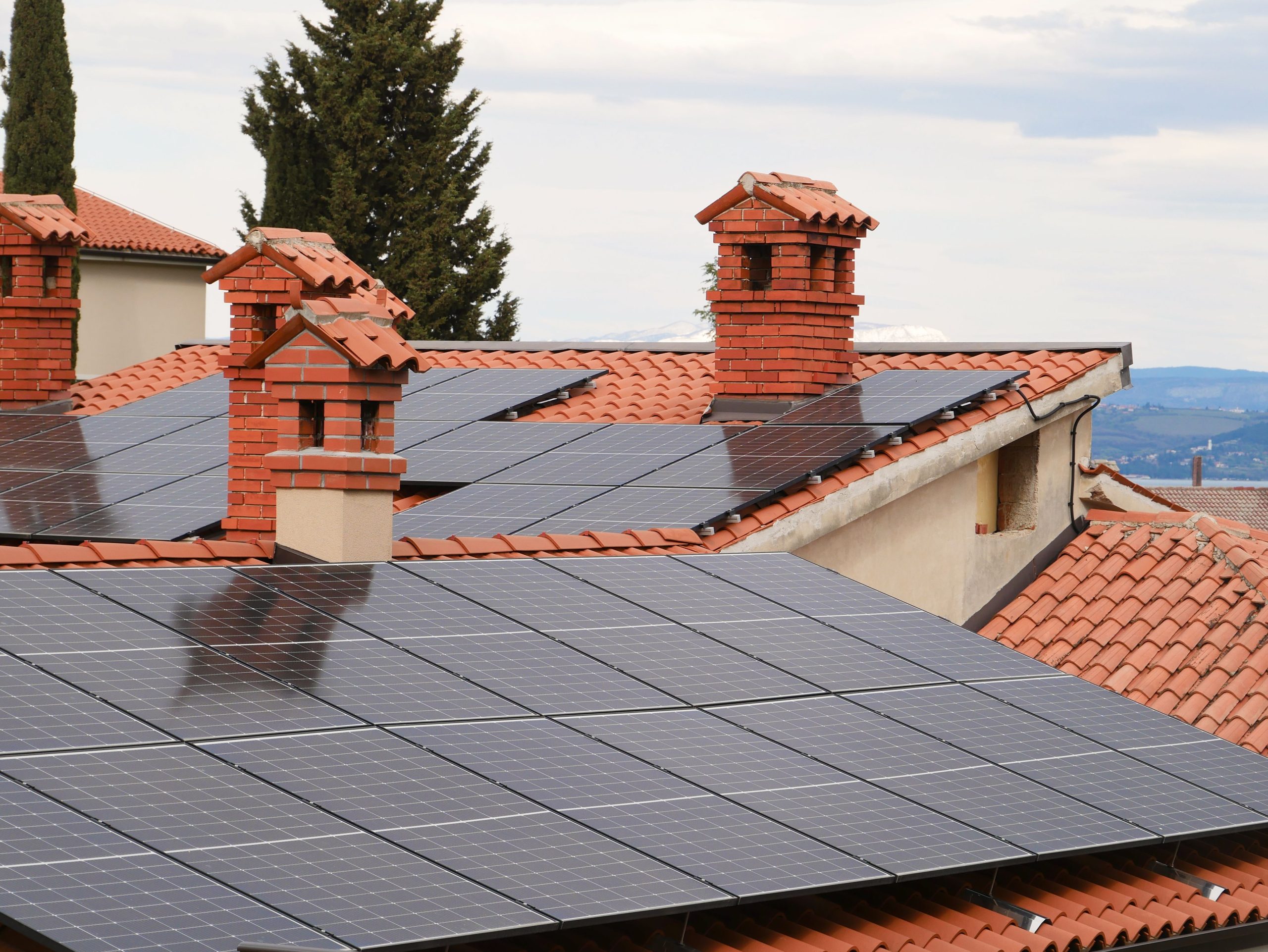
Shading can greatly reduce how much power your panels produce. Look for trees, chimneys, nearby buildings, or vents that cast shadows on your roof during the middle of the day. Trimming trees may help. Technology like microinverters or power optimizers can reduce the impact of partial shade. Also check your roof’s age and condition. If it will need replacing within the next 5 to 10 years, it’s often smarter to replace it before installing solar.
- Each panel needs about 20 square feet of roof space, plus setbacks.
- South-facing roofs typically produce the most power.
- Reduce shading and replace an aging roof before installing panels.
7. Plan for Future Needs and Batteries
Your solar system should fit not just your home today, but also your home in the years ahead. Think about any big changes that could increase your electricity use. Common examples include buying an electric vehicle, switching from a gas furnace to a heat pump, adding a hot tub or pool, finishing a basement, or welcoming more family members into your home.
An electric vehicle can add a lot of demand. Depending on how far you drive, charging an EV at home might add around 2,000 to 4,000 kWh or more per year, which could mean several extra panels. If you expect changes like these, talk to your installer about sizing your system a little larger now or making sure it can be expanded later. Adding panels after installation is possible but can cost more than including them from the start.
You may also want to consider a home battery. Batteries store extra solar power during the day so you can use it at night or during a power outage. They add to the cost but can be valuable if your area has frequent outages or if your utility pays less for the extra solar power you send back to the grid. Your installer can help you decide whether a battery makes sense for your goals.
- Plan for future changes like an EV, heat pump, or home addition.
- Consider sizing up now or designing a system that can grow.
- Batteries add backup power and help you use more of your own solar energy.
8. Understand Costs, Incentives, and Net Metering
Solar is usually priced per watt. Installed costs for home systems often fall somewhere around $2.50 to $3.50 per watt, though prices vary by state, installer, equipment, and roof type. At those rates, an 8 kW system might cost roughly $20,000 to $28,000 before any incentives. Getting multiple quotes is the best way to know what’s fair in your area.
Incentives have changed recently. The 30 percent federal Residential Clean Energy Credit, which many homeowners used to lower their costs, ended for systems installed after December 31, 2025. That means homeowners who buy a system in 2026 can’t claim that federal credit. However, many states, cities, and utilities still offer rebates, tax credits, property tax exemptions, or performance payments for solar. Check the DSIRE database at dsireusa.org and ask local installers about current programs, since incentives change often.
Net metering also affects your savings. Under net metering, your utility gives you credit for extra power your panels send to the grid, which you can use when your panels aren’t producing. Rules vary widely. Some utilities offer full retail credit, while others pay much less. Understanding your local policy helps you decide how big your system should be and whether a battery makes sense.
- Home solar often costs about $2.50 to $3.50 per watt installed.
- The federal homeowner solar tax credit ended after 2025, but state and local incentives may still help.
- Net metering rules vary and can greatly affect your savings.
9. Choose an Installer and Take the Next Steps
Your estimate is a great starting point, but a professional installer will design the final system. A good installer will review your utility bills, inspect your roof, check for shading, and use software to model how much power your system will produce. They’ll also handle permits, utility paperwork, and inspections.
Get quotes from at least three licensed, insured installers. Look for companies with solid local experience and strong reviews, and check for certifications like NABCEP, which shows installers have specialized training. Compare quotes on system size, panel and inverter brands, estimated yearly production, total cost, cost per watt, and warranties. Quality systems usually include a 25-year panel warranty and a workmanship warranty from the installer.
Think carefully about how you’ll pay. Buying with cash usually offers the best long-term savings. Solar loans let you own the system while spreading out payments. Leases and power purchase agreements, often called PPAs, let a company own the panels while you pay for the power, which lowers upfront costs but usually reduces your total savings. Read all contracts closely, and watch for high-pressure sales tactics or promises that sound too good to be true.
- Have a professional design your final system.
- Compare at least three quotes from licensed, experienced installers.
- Weigh the pros and cons of buying, financing, leasing, or a PPA.
Conclusion
Figuring out how many solar panels your home needs doesn’t have to be complicated. Start with your yearly electricity use, factor in your area’s peak sun hours, and choose a panel wattage. With a simple formula and a little math, you can get a solid estimate. Many homes end up needing somewhere around 15 to 25 panels, but your number could be higher or lower depending on your situation.
Remember that the right system also depends on your roof’s space, direction, and shading, along with any future changes like an electric car or new heating system. Costs and incentives vary by location, and the federal homeowner tax credit is no longer available, so research state and local programs and compare several quotes before you decide.
Going solar is a long-term investment in your home, your budget, and the planet. Take the first step by gathering your past year of electric bills and running a quick estimate. Then reach out to a few trusted local installers. With the right plan, you can power a greener home for decades to come.